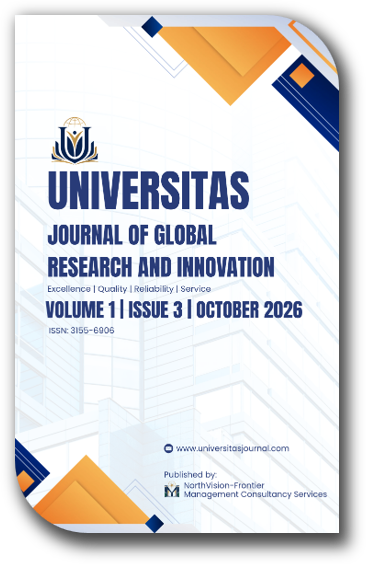
Relationship between Financial Literacy, Debt Management, and Financial Decision-Making among the Employees of BIR RDO 108 – Cotabato Province and BARMM Special Geographic Area
DOI:
https://doi.org/10.5281/zenodo.23944922Keywords:
Financial Literacy, Debt Management, Financial Decision-Making, Financial Behavior, Financial Planning, Financial Capability, BIR EmployeesAbstract
This study examined the relationship between financial literacy, debt management, and financial decision-making among employees of the Bureau of Internal Revenue (BIR) Revenue District Office 108 – Cotabato Province and the Bangsamoro Autonomous Region in Muslim Mindanao (BARMM) Special Geographic Area. The study used a quantitative descriptive-correlational design, with 63 respondents who answered a standardized questionnaire using a five-point Likert scale. The study analyzed data using descriptive statistics, Pearson correlation, and exploratory multiple linear regression.
Respondents reported very high levels of financial literacy (M = 4.50), debt management (M = 4.45), and financial decision-making (M = 4.40). Financial literacy and debt management were strongly and positively related (r = .887), as were financial literacy and financial decision-making (r = .845) and debt management and financial decision-making (r = .928), all at p < .001. The regression model explained 86.4% of the variance in financial decision-making. Debt management remained a statistically significant predictor when both variables were considered, while financial literacy did not show a significant unique contribution.
The study shows that financial literacy and debt management are strongly associated with financial decision-making among the respondents, with debt management showing the strongest relationship. The findings highlight the importance of strengthening practical financial management skills, particularly savings, debt repayment, and awareness of financial risk. Workplace financial education programs may help employees develop more consistent financial practices.
Downloads
References
Allgood, S., & Walstad, W. B. (2016). The effects of perceived and actual financial literacy on financial behaviors. Economic Inquiry, 54(1), 675–697. https://doi.org/10.1111/ecin.12255
Apostol, R. E., Maitom, J. G., Manus, M. I., Ravelo, S. P., Saligumba, J. K. C., & Susada, J. M. (2025). Financial literacy and retirement preparedness among government employees: A correlation analysis. Asian Journal of Education and Social Studies, 51(8), 683–698. https://doi.org/10.9734/ajess/2025/v51i82269
Carvajal, W. C., Baltonado, C. M., Gocela, M. G., Pajes, L. J., Soliman, A. J., Bankas, H., . . . Albano, M. E. (2025). Level of Financial Literacy and Debt Management: Basis for Personal Financial Management Program. Psychology and Education: A Multidisciplinary Journal, 206-215.
Dew, J., & Xiao, J. J. (2011). The Financial Management Behavior Scale: Development and validation. Journal of Financial Counseling and Planning, 22(1), 19–35. https://scholarsarchive.byu.edu/facpub/4521/
Donggon, G., Felicitas, C., Senerez, M. S., & Petalcorin, C. I. (2024). Influence of Financial Literacy on the Investment Decisions of Small and Medium Enterprise Owners. Business and Organization Studies E-Journal, 25-39.
French, D., & McKillop, D. (2016). Financial literacy and over-indebtedness in low-income households. International Review of Financial Analysis, 48, 1–11. https://doi.org/10.1016/j.irfa.2016.08.004
Lusardi, A., & Tufano, P. (2015). Debt literacy, financial experiences, and overindebtedness. Journal of Pension Economics & Finance, 14(4), 332–368. https://doi.org/10.1017/S1474747215000232
Lusardi, A., & Mitchell, O. S. (2014). The Economic Importance of Financial Literacy: Theory and Evidence. Journal of Economic Literature, 5-44.
Lusardi, A., & Tufano, P. (2009). Debt Literacy, Financial Experiences, and Overindebtedness. National Bureau of Economic Research, 1-44.
Organisation for Economic Co-operation and Development. (2023). OECD/INFE 2023 international survey of adult financial literacy. OECD Business and Finance Policy Papers, No. 39. OECD Publishing. https://doi.org/10.1787/56003a32-en
OECD. (2022). OECD/INFE toolkit for measuring financial literacy and financial inclusion 2022. https://www.oecd.org/financial/education/2022-INFE-Toolkit-Measuring-Finlit-Financial-Inclusion.pdf
Unciano, M. E., & Perono, I. R. (2024). Assessing financial literacy and money management of the employees in selected government academic institutions. The Trinitian Researcher, 12(1). https://ejournals.ph/article.php?id=27076
Downloads
Published
Issue
Section
License
Copyright (c) 2026 Angelou Colleen E. Calma, Theresa Mae A. Pabiona, Hazel Anne N. Reyes, Maricris G. Unico, Marmelo, V., Abante (Author)

This work is licensed under a Creative Commons Attribution 4.0 International License.